
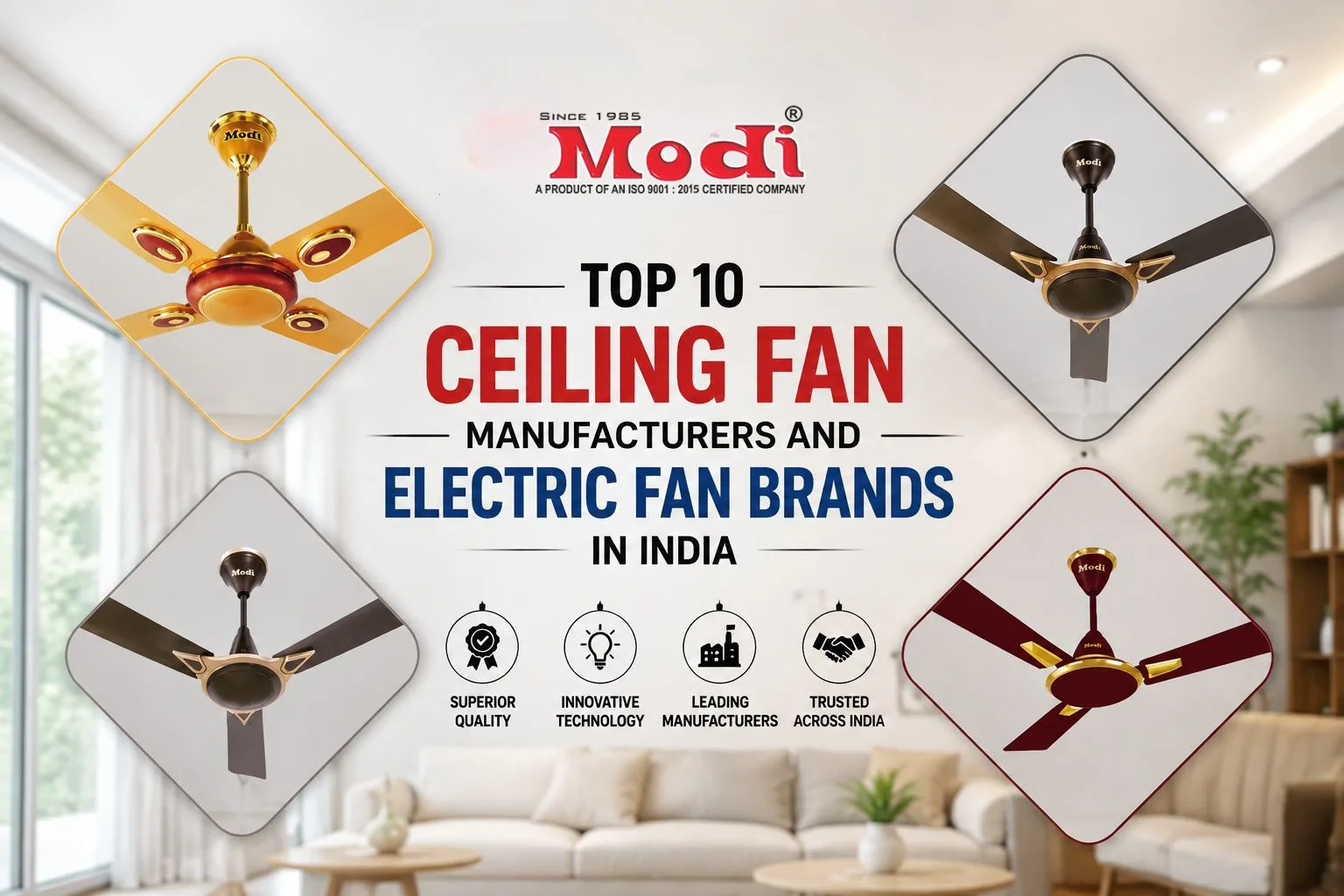
Ceiling fans remain one of the most widely used cooling appliances in Indian homes, offices, shops, institutions, and commercial spaces. With increasing attention on electricity consumption, airflow, motor efficiency, durability, and smart features, buyers now have more choices than ever. This has also made the search for the Top 10 Ceiling Fan Manufacturers and the Top Electric Fan Brand in India more relevant for consumers and businesses comparing different options.
The Indian fan market includes established electrical companies, specialised BLDC fan brands, and manufacturers offering conventional as well as decorative and utility fans. Instead of judging a brand only by popularity, buyers should consider factors such as air delivery, power consumption, motor technology, sweep size, noise level, warranty, service availability, and intended application.
This guide presents 10 notable ceiling fan manufacturers and electric fan brands in India, with the brands mentioned as a reference rather than as a ranking based on sales or popularity.
What Makes a Ceiling Fan Brand Worth Considering?
A good fan is not simply about producing a strong breeze. Several technical and practical factors influence its overall usefulness:
- Air delivery: Indicates the volume of air moved by the fan and is an important performance parameter.
- Power consumption: Lower electricity consumption can help reduce running costs, particularly when fans operate for several hours every day.
- Motor technology: Conventional induction motors and newer BLDC motors offer different combinations of performance, efficiency, controls, and cost.
- Sweep size: Common ceiling-fan sizes include 900 mm, 1050 mm and 1200 mm, with the appropriate size depending on room dimensions and installation conditions.
- Speed and RPM: Higher RPM does not automatically mean better cooling; airflow and blade design should also be considered.
- Build quality: Motor construction, bearings, blades, coating and material quality can affect durability.
- Noise: Important for bedrooms, offices, classrooms and other spaces where quiet operation matters.
- After-sales service: Warranty coverage and access to service centres can be important over the fan’s working life.
The Bureau of Energy Efficiency (BEE) uses energy labelling to help consumers compare the energy performance of similar appliances.
Top 10 Ceiling Fan Manufacturers and Electric Fan Brands in India
- Modi India Pvt. Ltd.
- Atomberg
- Bajaj
- Crompton
- Havells
- Orient Electric
- Polycab
- Usha
- V-Guard
- Luminous
Brand Comparison Matrix
Rather than assigning an arbitrary rank to each company, the following matrix compares some of the key areas buyers commonly consider.
Brand | Core Strength | Key Technology / Focus | Typical Price Range* |
Modi India | Fan manufacturing and B2B Supply expertise since 1985 | Ceiling, pedestal, table & other electric fans | Model-dependent; need to contact. |
Atomberg | Energy efficiency & smart features | BLDC motors & smart controls | ₹2,700–₹10,500 |
Bajaj | Broad accessibility & affordability | Conventional & BLDC options | ₹1,200–₹8,000 |
Crompton | Wide product range & established presence | Conventional & BLDC fan technologies | ₹1,700–₹6,000 |
Havells | Premium designs & features | BLDC & decorative fan technologies | ₹2,300–₹11,000 |
Orient Electric | Airflow, design & product variety | Aerodynamic blade designs & BLDC models | ₹1,600–₹13,000 |
Polycab | Consumer electrical portfolio | Conventional & BLDC options | ₹1,200–₹7,000 |
Usha | Household electrical solutions | Energy-efficient & conventional models | ₹1,500–₹7,000 |
V-Guard | Household electrical solutions | Energy-efficient & conventional models | ₹1,500–₹7,000 |
Luminous | Residential electrical solutions | Conventional & energy-efficient fan options | ₹1,500–₹7,000 |
*Price ranges are indicative market ranges and can vary significantly according to model, size, motor technology, features, retailer, offers, and location. They should not be treated as official brand pricing.
Conventional Fans vs BLDC Fans: What Should You Choose?
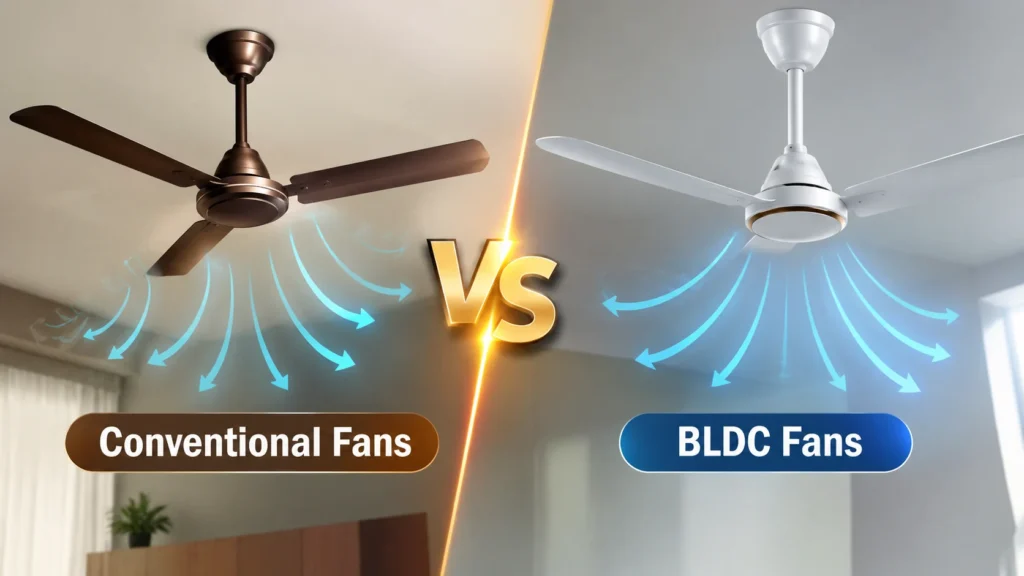
One of the biggest changes in the fan market is the growing adoption of BLDC motor technology.
Conventional Fans
Conventional induction-motor fans are widely available and generally have:
- Simple operating mechanisms
- Broad availability
- Lower initial purchase prices in many cases
- Familiar regulator-based controls
- A wide selection of models and designs
They can be suitable when initial purchase cost and straightforward operation are the main considerations.
BLDC Fans
BLDC fans are designed around brushless DC motor technology and are generally associated with lower electricity consumption, quieter operation and electronic controls.
Common features may include:
- Remote control
- Multiple speed modes
- Timer or sleep functions
- Lower power consumption
- Smart connectivity in selected models
- Low-noise operation
A Department of Consumer Affairs comparative test of selected BLDC ceiling fans found tested products consuming between 26.9 W and 35.42 W, with the tested models carrying 5-star ratings under the applicable testing framework.
However, the actual performance and electricity consumption depend on the specific model, operating conditions and applicable energy label.
Why Air Delivery Matters More Than RPM Alone
RPM is one of the specifications buyers frequently look at when comparing fans. However, it should not be used as the only measure of cooling performance.
A fan operating at a high RPM does not necessarily provide better room cooling than a slower fan. Blade profile, blade angle, motor characteristics, sweep size and air-delivery performance all contribute to the result.
For example, government comparative testing has evaluated ceiling fans using parameters such as air delivery, service value and power consumption rather than speed alone.
For this reason, when comparing models from different manufacturers, look at air delivery and power consumption together.
How to Choose the Right Ceiling Fan for Your Room
For Bedrooms
Look for:
- Quiet operation
- Appropriate sweep size
- Smooth speed control
- Energy-efficient operation
- Remote or timer functionality if preferred
For Living Rooms
Consider:
- Air delivery
- Room size
- Decorative design
- Sweep size
- Energy efficiency
For Offices
Prioritise:
- Long operating hours
- Energy consumption
- Low noise
- Reliability
- Service and warranty support
For Shops and Commercial Areas
Consider:
- Air circulation requirements
- Operating hours
- Durability
- Maintenance requirements
- Installation conditions
For Industrial or Utility Spaces
The appropriate fan may not always be a standard ceiling fan. Depending on the application, pedestal fans, wall fans, cabin fans, air circulators or exhaust fans may be more suitable.
What Should You Check Before Buying an Electric Fan?
Before selecting a fan, compare these specifications:
1. Motor Type
Check whether the fan uses a conventional induction motor or BLDC technology.
2. Power Consumption
Check the wattage and applicable BEE information rather than assuming that every model from the same brand has identical efficiency.
3. Air Delivery
Higher air delivery can be useful for spaces requiring stronger circulation, but the appropriate performance depends on the room and installation.
4. Sweep Size
Choose a sweep appropriate to the room size and mounting conditions.
5. Blade Design
Blade profile and pitch influence the way air is circulated.
6. Warranty
Compare warranty duration and understand what components and service conditions are covered.
7. Service Availability
A reliable service network can be particularly important for fans used in offices, commercial spaces and other locations where downtime is inconvenient.
8. Installation Requirements
Check ceiling height, mounting arrangement, electrical supply and available space before installation.
Is a 5-Star Fan Always the Best Choice?
Not necessarily.
A higher energy rating can indicate better energy efficiency, but the best fan for a particular user depends on more than the star label. Air delivery, room size, operating hours, noise, price, warranty and features should also be considered.
BEE explains that comparative energy labels are intended to help consumers compare the energy performance of similar appliances and consider running costs when making purchasing decisions.
Therefore, a practical buying decision should consider efficiency + airflow + usage + price + service, rather than focusing on one specification.
How Modi India Fits into the Indian Fan Market

Modi India Pvt. Ltd. is among the trusted Indian manufacturers offering a broad selection of electric fans like (Yash ceiling fan, Freedom ceiling fans, True value deco, Leo Ceiling fan). Its official product information lists ceiling fans, table fans, pedestal fans, air circulator fans and exhaust fans among its product categories.
For example, current product listings for Modi models show specifications such as 1200 mm sweep sizes, 50 W power consumption, copper winding and 405 RPM on selected conventional ceiling-fan models. Specifications vary by model, so buyers should check the individual product specifications before making a decision.
This broader product mix makes the company relevant not only to buyers searching for a ceiling fan but also to those looking for different types of electric fans for homes, offices and utility spaces.
What Is the Future of Electric Fans in India?
The fan industry is moving toward a combination of energy efficiency, improved motor technology, better airflow engineering and smarter controls.
BLDC motors are an important part of this transition. At the same time, conventional fans continue to have a role because of their affordability, availability and familiarity.
The wider market data also shows substantial room for improving fan efficiency. A report on super-efficient ceiling fans notes that the BEE programme uses service value to evaluate efficiency and that 5-star-rated 1200 mm fans under the cited framework can achieve a service value of 6 or more, corresponding to 35 W or lower consumption.
For consumers, this means the next generation of fans is likely to focus increasingly on lower energy consumption without compromising airflow and everyday usability.
Final Thoughts
The Indian fan market offers options for almost every requirement, from affordable conventional ceiling fans to premium decorative models and technology-focused BLDC fans. Instead of choosing a manufacturer simply because it appears on a popular list, compare the actual model specifications, air delivery, power consumption, motor technology, warranty and service support.
The Top 10 Ceiling Fan Manufacturers and electric fan brands discussed here represent different approaches to fan design and manufacturing. Similarly, there is no single Top Electric Fan Brand in India that will be the right choice for every room, budget or application.
For a practical decision, start with your room size and usage requirements, then compare airflow, energy efficiency, motor technology, features and long-term ownership costs.
Frequently Asked Questions
Some widely recognised names include Atomberg, Bajaj, Crompton, Havells, Khaitan, Modi India, Orient Electric, Polycab, Usha and V-Guard. The best choice depends on the specific model, application, budget and required features.
There is no single brand that is objectively best for every requirement. The right choice depends on factors such as airflow, power consumption, motor technology, price, warranty and service availability.
BLDC fans generally consume less electricity than conventional induction-motor fans, although actual consumption varies by model and operating conditions.
BLDC fans can offer lower power consumption, quieter operation and additional electronic features. Conventional fans may still be preferable where lower upfront cost and simple operation are the priority.
Check air delivery, power consumption, BEE rating where applicable, sweep size, motor type, speed, noise, build quality, warranty and service support.
Not always. RPM is only one performance parameter. Air delivery, blade design, motor efficiency and sweep size should also be considered.
The appropriate sweep depends on the room’s dimensions, ceiling height and installation conditions. A 1200 mm fan is commonly used for many standard rooms, while smaller or larger spaces may require different sizes.
Choose an energy-efficient model, use the appropriate speed instead of running at maximum unnecessarily, keep blades clean, maintain the motor and consider a BLDC model if it suits your usage pattern.
They can be worthwhile for users who operate fans for many hours because better energy efficiency can reduce running costs. However, compare the fan’s actual airflow, purchase price and expected usage rather than considering the star rating alone.
Yes. Modi India Pvt. Ltd. identifies itself as a manufacturer and supplier of electric fans, with product categories including ceiling, table, pedestal, air circulator and exhaust fans. Its official information states that its fan manufacturing operations were established in 1985.